The latest edition of the Herald looks at the ‘ongoing water issues’ of the River Otter over the last decades and centuries and in that context asks What does Ottery St Mary’s future look like?. As the writer Josefina Gori says:
As I delved into the town’s historical records, I found a late-1800s account of torrential rains that turned the River Otter into a raging flood, disrupting the village. Residents worked together to cope with the chaos, showing a longstanding concern about flooding. This theme appears throughout historical and modern records – a problem that remains on everyone’s mind.
Back in 2021, local historian Chris Hallam provided a closer look at flooding in Devon throughout the years – and as he says:
There have long been incidents of flooding before in Devon. In October 1625, for example, it was recorded, “a momentous flood swept through the valley, causing great devastation. In the town of Tiverton alone 53 houses were destroyed” while in 1877, Exeter, Crediton and many other places were reported to “have suffered greatly from floods.”
There is a lot of documentation on the flooding of East Devon’s rivers, from the local history website Exeter Memories on the October and December 1960 floods in Exeter to the official Flood Investigation Report on the River Axe 4-7th December 2023.
These pages have a special section looking at flooding in the Sid Valley – giving a long-term view to the issues, looking at more recent causes, including development, climate change and run-off from farmland.
For an excellent overview, we can turn to the pages of Sidmouth Nature and the River History – including its ‘flashy nature’ which has been the main issue with the Sid River over the years. Here’s a pictogram which illustrates the river’s development:
.
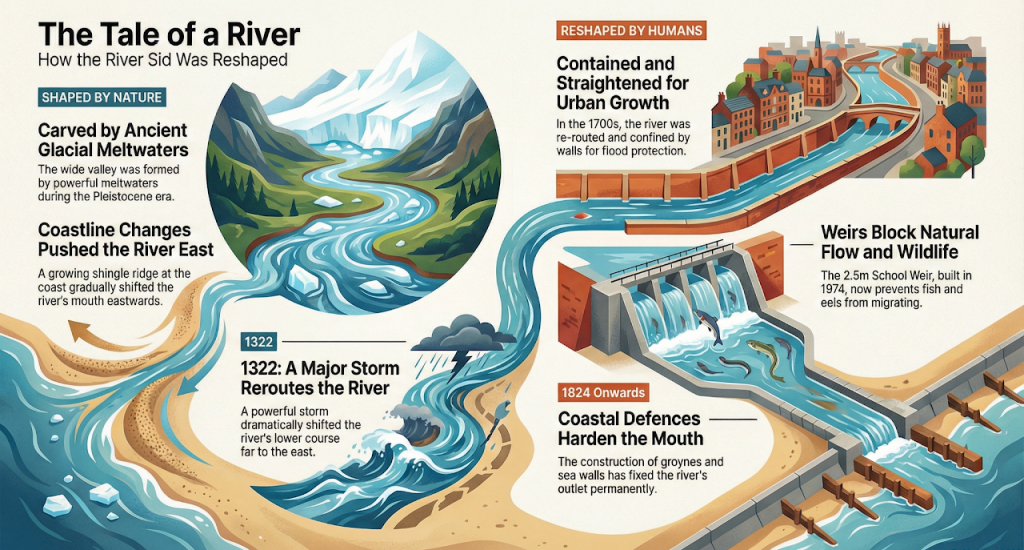
The River Sid we see today is the result of thousands of years of geological shifts and centuries of human engineering. Understanding its history helps us grasp why the river behaves the way it does today.
…